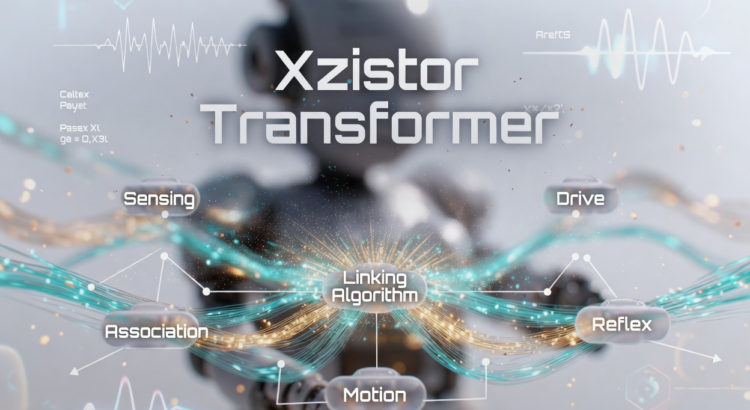
Essay Summary
The Xzistor Mathematical Model of Mind proposes that every behaviour, memory and felt emotion in a biological or artificial agent serves a single purpose — keeping a finite set of physiological and allostatic needs within tolerable ranges — and that this homeostatic control loop, not pattern-matching on data, is the mechanism that makes learning both necessary and self-sustaining. In the XMMM, emotions are not a display layer but the primary motivational force: when a chain of actions reduces a need, the resulting relief signal propagates back through all the preceding cues and actions that contributed, gradually charging even distant environmental landmarks with their own emotional weight; needs also generate anticipatory stress before errors become critical, which is the computational origin of anxiety, longing and goal-directed planning. The key structural component that allows this logic to scale from a simple robot to human-adult cognitive complexity is the Xzistor Transformer — an adaptive association buffer that reshapes itself in real time under the influence of emotional valence and need-state signals, analogous in its architectural role to what the 2017 Transformer was for language: not a replacement for the underlying learning machinery, but the one addition that makes it scale. In the proposed hybrid architecture, this control-theoretic symbolic core retains sole authority over every action decision while four neural-network helpers — a fast neural association index, a gut-feel aggregator, a parallel threading accelerator, and a foundation-model seeding interface — handle the computational heavy lifting around it; crucially, no output from any of these connectionist components can override what the agent genuinely needs, which means alignment shifts from a software instruction problem to a structural property of the design itself. The result is a system that, for the first time, would simultaneously exhibit genuine goal-directed learning, real cross-domain generalisation, intrinsic motivation, and safe alignment at human-adult associative scale — a combination no existing architecture possesses — and that, given the current availability of embodied robotic hardware, large foundation models, and GPU compute, the authors argue is achievable within 12–24 months of focused open collaboration.