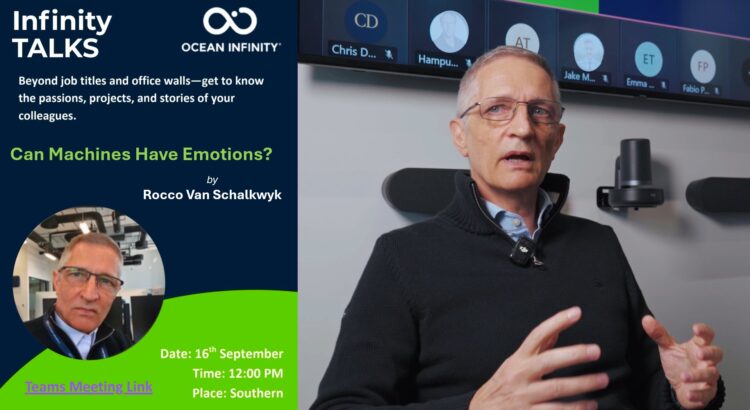
In this Infinity TALK, Rocco Van Schalkwyk, developer of the Xzistor Mathematical Model of Mind, offers a simple explanation of how his Xzistor brain model can provide robots with subjective ‘body-felt’ emotions that are principally no different from those experienced by humans.
Links to information mentioned in the talk can be found at the bottom of the following Xzistor LAB website – go here.
Summary of “How the Xzistor Mathematical Model of Mind creates Machine Emotions” by Gemini AI:
In this talk, Rocco Van Schalkwyk presents his Xzistor Mathematical Model of Mind, arguing that machines can be equipped with genuine, subjective, “body-felt” emotions that are principally no different from those experienced by humans [02:13, 40:01].
The central message is that emotions are the subjective experience of homeostatic drives (the mechanisms that keep a biological or robotic system in a stable, preferred state). The Xzistor model’s unique feature is how it makes the robot “aware” of these drives.
Here is a breakdown of the core argument:
- The Problem with Data: Van Schalkwyk begins by explaining that standard sensory inputs (like touch, sight, or sound) are just turned into “numerical representations” or “stone cold spreadsheets” [03:12, 09:52]. By themselves, these numbers mean nothing to the robot.
- The Need for Motivation (Drives): To be motivated, a robot needs “drives,” similar to human biological needs [12:32]. He uses the example of a robot needing to keep its battery charged [12:42]. This creates a “homeostat” (like a thermostat) [17:02].
- The Xzistor Solution (The “Body-Felt” Emotion): The key problem is that the robot’s “executive” (its decision-making part) isn’t naturally aware of these homeostat states (like “battery level”) [22:17].
- The Xzistor model solves this by embedding these homeostat states (like hunger, pain, or the battery-level drive) directly into the robot’s internal “body map” [23:34].
- This “body map” is the same system the robot uses to process its sense of touch. The homeostats are “hijacked” and represented in an area analogous to the human intra-abdominal or gut area [23:54].
- Because these drives (like “low battery”) now exist within the body map, the robot experiences them in the same way it experiences touch—as a feeling [26:20].
- How it Works: The robot learns to label these feelings. The “bad” feeling of deprivation (e.g., a low battery) motivates it to find a charger [26:41]. The “good” feeling of satiation (e.g., the battery charging) reinforces the actions that led to it [28:19].
- Complex Emotions (Stress): This model extends to complex emotions. For example, stress is also a homeostat [29:03]. Van Schalkwyk explains that a robot learns to avoid danger not by re-feeling pain, but by feeling the stress it has associated with the memory of that danger [31:06, 31:14]. This stress-driven system is what allows the robot to learn complex, multi-step tasks [31:49].
- Parallels to the Human Brain: Van Schalkwyk concludes by drawing strong parallels between his model and the biological brain:
- Xzistor Body Map -> Somatosensory Cortex (processes touch) [36:09].
- Xzistor “Homeostat Factory” (where feelings are generated) -> Insula (linked in humans to emotion, interoception, and homeostasis) [36:59].
- Xzistor Executive (decision-making) -> Thalamus (the brain’s central hub for sensory information and awareness) [38:56].
Ultimately, Van Schalkwyk argues that by grounding emotions in these body-felt homeostatic drives, the Xzistor model provides a concrete blueprint for creating “sentient, emotionally aware agents” [41:54].